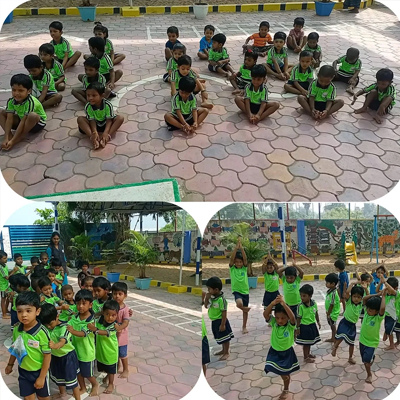
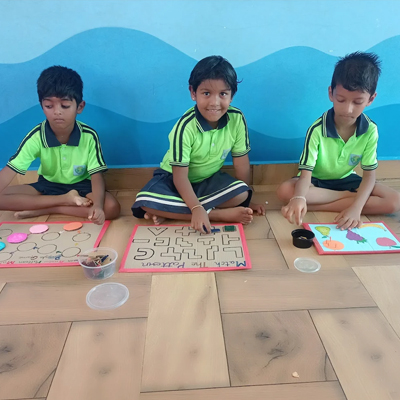
A good daycare center not only takes care of your child but also uses various activities to teach and develop different skills. Some benefits of putting your child in daycare are:
1. Toddlers in daycare learn the basics of academics such as letters of the alphabet, numbers, shapes, colours, and so on through primers, toys, and games.
2. By using various toy-based and group activities, the trained staff can help your child develop:
• cognitive skills
• social skills
• fine and gross motor skills
3. Socialising with other children enhances your child's communication skills.
4. Going to a daycare centre makes your child's transition to preschool much easier.
5. When encouraged by caregivers, your child would be more willing to try new foods and stop being a picky eater.
6. The structured environment in a daycare centre keeps your child occupied and decreases the chances of developing erratic behaviour.
Play Group
Play Group (2 to 2.5 Years)
We The India Kidz School not only to provide basic childcare services but also help with early learning. So, they have a significant impact on the overall development of a child.
OUR FEATURES
Safety of the child
Teacher/caregiver support
Caregiver and child ratio
Child's comfort levels
Transparency
Parent communication
Pre-Kg
Focusing on basic literacy, numeracy, and life skills.
Foundational academic exposure
• Activities like storytelling, singing, and learning to recognize letters to build a foundation for reading and writing.
• Learning number concepts, spatial relationships, and shapes.
• Exploring the natural world through topics like animals, plants, and materials.
Motor skills
• Activities like colouring, grasping objects to improve hand-eye coordination, which helps with writing.
• Developing physical abilities through runningand balancing.
Learning environment
• The curriculum uses playful, interactive activities and group play to teach concepts.
• Combining organized playtime with free exploration
• Providing a secure and supportive setting where children can learn and grow.
LKG
• Recognizing and using basic letters (capital and small) and simple words.
• Learning through rhymes, stories, and phonics.
• Communicating clearly in short sentences and participating in conversations.
• Recognizing basic numbers (e.g., 1–50).
• Learning about shapes and colors.
• Fine Motor Skills: Activities like colouring, Practising strokes and drawing to improve hand control.
• Gross Motor Skills: Providing the Physical Activities.
• Learning to follow rules and share with peers.
• Developing emotional regulation and conflict resolution skills.
• Becoming more independent in tasks like eating, toileting, and managing belongings.
• Building confidence and getting comfortable in a structured learning environment.
• Learning about the world through themes like body parts, animals, seasons, and community helpers.
• Developing creativity
• Participating in group activities .
UKG
• Children move from recognizing letters to reading basic words and understanding phonics. They begin to form words and write simple sentences.
• The focus shifts to more advanced concepts like numbers up to 200, simple addition and subtraction, and comparing quantities (more and less).
• Lessons cover a broader range of topics, including festivals, different cultures, environmental concepts, and basic science principles, often through theme-based activities.
• Assessments will be conducted termwise and exams are used to track progress in foundational skills.
• They learn to express themselves effectively with peers and teachers and develop social etiquette.
• The program fosters a sense of responsibility through activities that encourage independent work and following routines.
• Children learn to work cooperatively in groups and develop an understanding of sharing and helping others.
• Art is a significant part of the curriculum, with activities like drawing, painting, and collage to encourage self-expression.
• The primary goal is to make children ready for the transition into formal schooling by strengthening their academic foundation and confidence.
• The curriculum aims for the balanced development of a child's physical, cognitive, language, social, and emotional skills.
• It aims to instill a love for learning through engaging activities and projects, making the transition to primary school a positive experience.